
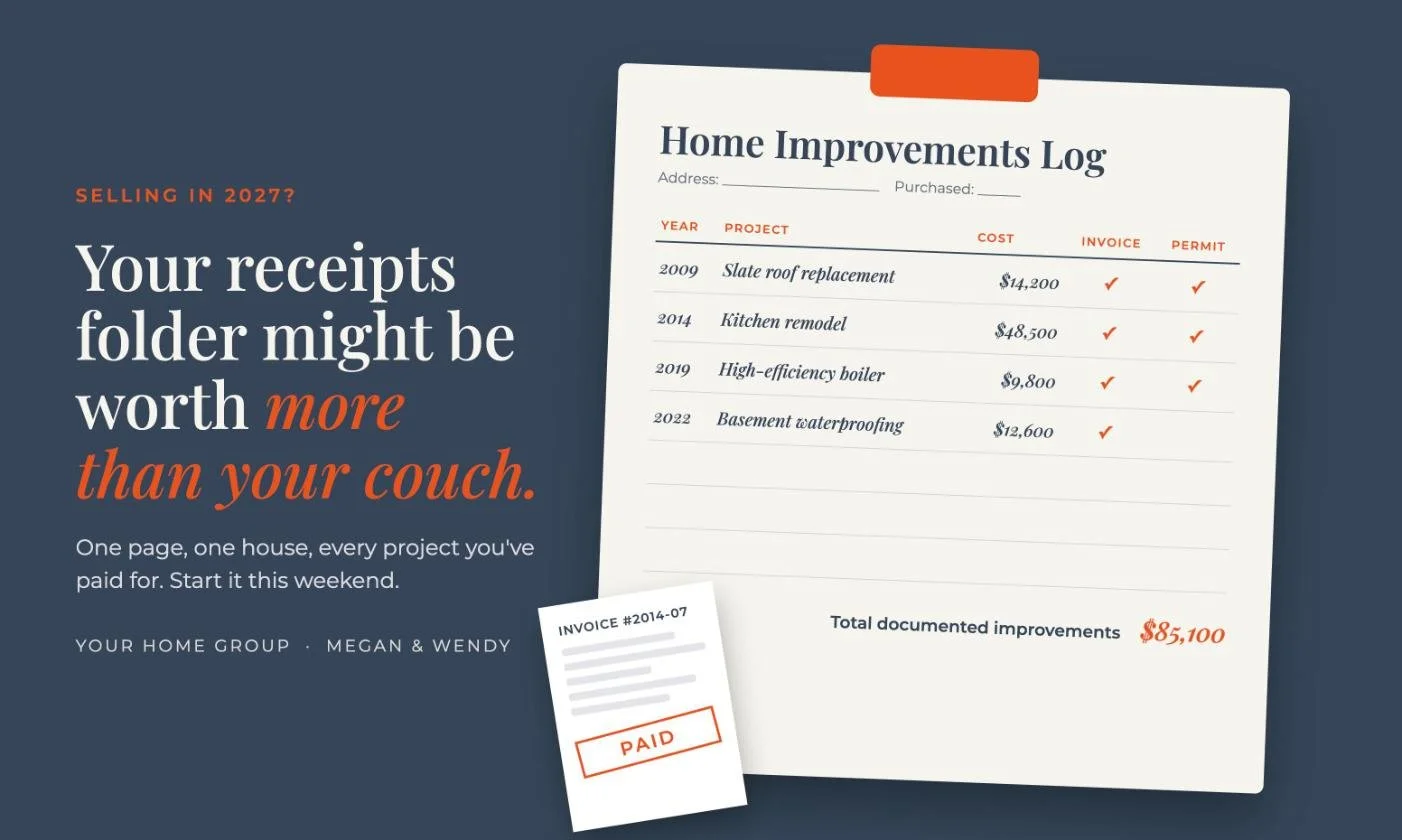
That shoebox of receipts in the hall closet? The one wedged behind the vacuum, holding a Home Depot slip from 2011 and a takeout menu you swear you'll use? It might be one of the most valuable things in your house. 🧾
Here's the serious part. When you sell, the IRS looks at how much your home gained in value while you owned it. Every dollar you put into real improvements can shrink that number — but only if you can prove you spent it.
If you've owned an older home in Mt. Washington, Guilford or Anneslie for 15, 20, 30 years, you've likely spent real money on roofs, kitchens, furnaces and wiring. Let's make sure that money counts.
First, the word nobody explains: "basis"
Your basis is what you paid for the house, plus what you've spent on qualifying improvements. Your taxable gain is roughly your sale price, minus your selling costs, minus your basis.
The higher your basis, the smaller your gain. That's the whole game.
Here's an example adapted from Inman, using IRS Publication 523's method. These are round, illustrative numbers, not a promise about your house:
What you paid: $500,000
Plus improvements you can document: + $100,000
Your adjusted basis: about $600,000
Sale price: $900,000
Minus selling costs: – $50,000
What you walk away with, on paper: about $850,000
Your gain: about $250,000
Now imagine you lost the paperwork on that $100,000. On paper, your gain just grew by $100,000. Same house, same kitchen, bigger tax bill.
The break most homeowners already get
Good news first. Many sellers of a primary home owe nothing on the gain, thanks to the home sale exclusion (IRS Publication 523):
Up to $250,000 of gain is excluded if you file single.
Up to $500,000 if you're married filing jointly.
You must have owned it and lived in it for at least 2 of the last 5 years before the sale.
You can use it once every 2 years.
In the example above, a single seller with that $250,000 gain would land right at the line. Married sellers would have room to spare.
So why bother with receipts? Because long-time owners in older homes blow past those limits more often than you'd think. Buy in 1995, sell in 2027, and the gain can climb fast. Your improvements are what keep you under the cap.
Congress has floated bills to raise or remove the cap. As of mid-2026, none had passed. We'll recheck before your sale, and again each quarter.
Inherited a house? Different rules apply. Your starting basis is usually the home's value on the date of death, not what your parents paid in 1972. Maryland also has its own inheritance tax. We're writing a separate guide on that one.
What counts, and what doesn't
The rule of thumb: an improvement adds value or extends the life of the house. A repair just keeps it running.
Usually counts (improvements):
New roof, including slate work
Kitchen or bath remodel
Replacing the furnace, boiler or AC
Rewiring or a new electrical panel
Replacing plumbing lines
Waterproofing and finishing the basement
Adding a bath, deck or garage
Insulation and storm windows
Hardscaping: patios, walls, walkways
Usually doesn't (repairs and upkeep):
Patching a leak in the roof
Repainting a room
Servicing the furnace
Replacing a light switch
Fixing a dripping faucet
Patching drywall or plaster cracks
Cleaning gutters
Replacing one broken pane
Mulching and yard work
Two more things that surprise people:
Your own sweat doesn't count. The materials you bought for a DIY project can count. Your weekends can't.
Rented it out? Depreciation from those years lowers your basis, so your gain can be bigger than you expect.
Older Baltimore homes are improvement magnets. Knob-and-tube wiring, original boilers, wet basements, 100-year-old roofs — if you've owned one a while, you've probably replaced more than you remember.
Start your folder this weekend
A photo of a beautiful new kitchen proves the kitchen exists. It doesn't prove what you paid. The paper does.
Your first step is one folder (paper or digital) labeled with your address. Then, in this order:
Pull the big-ticket items first: roof, HVAC, kitchen, baths, electrical, basement (this weekend).
Gather contractor invoices and paid receipts for each one (as you find them).
Add proof of payment: canceled checks, card or bank statements (search your bank's history by contractor name).
Add permits and final inspection approvals (Baltimore City and County both keep permit records you can look up).
Add design, architect or engineer invoices, plus material receipts for any DIY work.
Snap before-and-after photos and file them with the invoice they belong to.
Keep a one-page log: what you did, the year, the contractor, the cost (update it every time you finish a project).
Can't find a receipt from 2014? Don't panic. Your contractor, your bank and the permit office may still have a record.
📄 Download our free Home Improvements Log (PDF) — a printable two-page log with a project table, a what-counts guide and a folder checklist.
You don't have to sort the shoebox alone
This is where we come in. You know what you've lived through in that house. We help you turn it into a clean record before the sign goes up.
Wendy, our licensed general contractor, can walk your house with you and help sort improvements from repairs, room by room.
We'll hand you our one-page Home Improvements Log so you're filling in blanks, not starting from scratch.
We'll fold it into your prep plan, so the same folder that helps at tax time also shows buyers what's been done.
Thinking about selling in 2027, or even 2028? Start the folder now, and give yourself a year to find what's missing.
👉 Get the free Home Improvements Log and start your folder this weekend.
Let's chat.
Megan & Wendy · Your Home Group · We're the agents who give a damn.
#YourHomeWithMeganAndWendy #guilford #anneslie #mtwashington #dickeyville #lauraville #timonium #hampden
